Chesapeake farms need field sanitation because hand-labor crews are covered by OSHA rules that require a toilet and water within a quarter mile walk. OSHA 1928.110 sets the ratio at one facility per 20 workers. Chesapeake Porta Pros delivers standard units, handwashing stations and holding tanks to farm sites across the city.
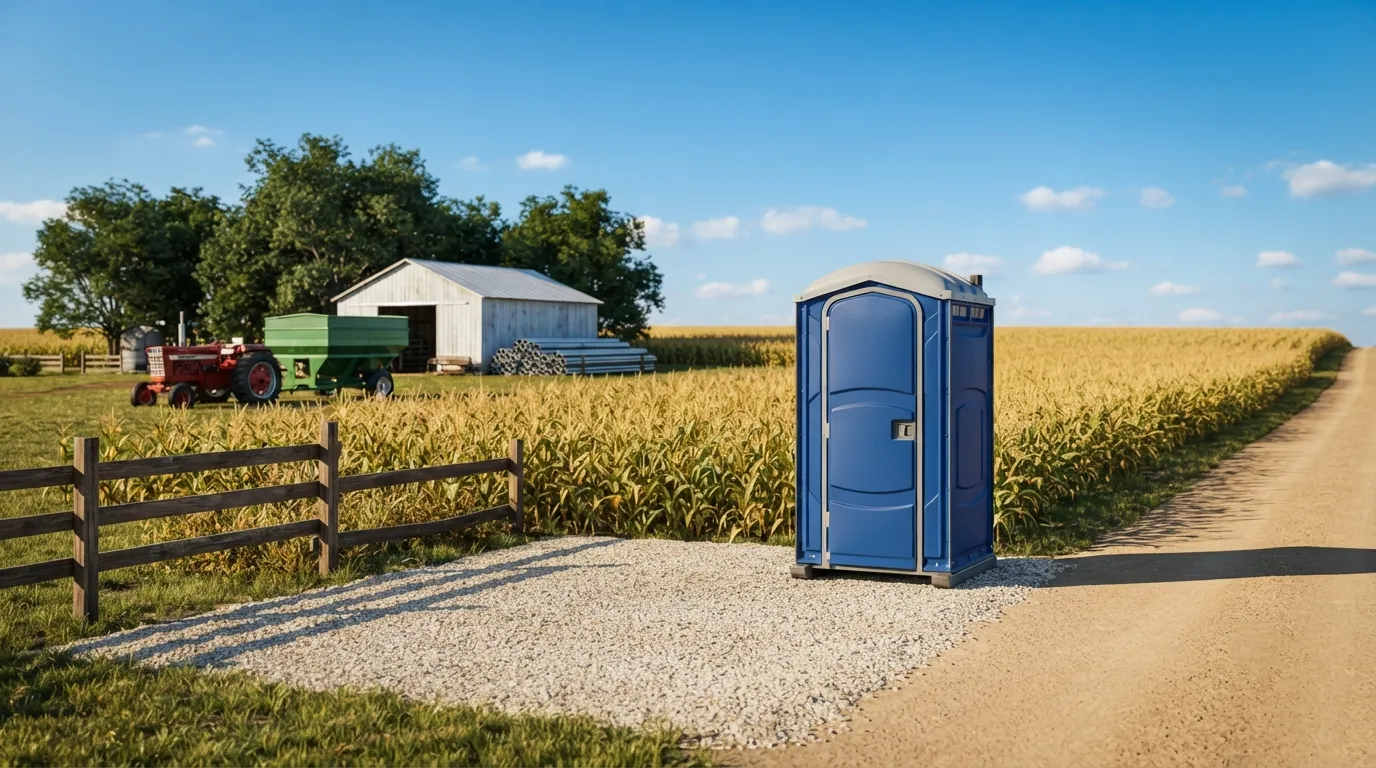
Farm labor sanitation isn't optional once you've got hired hands in the field. OSHA 1928.110 covers hand-labor operations in agriculture and sets the baseline: potable water, toilet facilities and handwashing, at a ratio of one facility per 20 employees, and every one of those facilities has to sit within a quarter mile of where people are actually working. That's different from a construction site, where OSHA 1926.51(c)(1) governs instead, with its own tiered ratios by crew size. If your operation runs both field labor and a building project, you may need to think through both standards, and OSHA Portable Toilet Requirements breaks down the difference in plain terms. Chesapeake Porta Pros sets units close to the rows or the packing shed, not at the far edge of the property, so the quarter mile rule stays satisfied even as crews move between fields. A standard portable toilet holds 60 to 70 gallons and stands about 92 inches tall, which is plenty for a full harvest week between service visits. Pair it with a handwashing station and you've covered both halves of the requirement in one delivery. If you're not sure how many units a crew of your size needs, How Many Porta Potties Do I Need walks through the math, and Farm and Agricultural Restrooms stays the hub page for everything tied to hand-labor sanitation here in Chesapeake.
Weekly service is the standard baseline, but harvest crews often need more. ANSI/PSAI Z4.3 sets one service visit per week for up to 10 users over a 40 hour week as the industry baseline interval, and that number holds up fine for a small crew tending a few acres. It falls apart fast once you've got two dozen seasonal workers pulling twelve hour days during a harvest push. Chesapeake Porta Pros scales the schedule up when the crew does, adding mid-week pumping so tanks never run past capacity in the heat. Farms out past Chesapeake toward Suffolk, about 28.3 miles west, or down near South Mills, 26.1 miles south, run on the same schedule logic even though the drive is longer for a delivery truck. If your fields sit close to livestock or spray operations, note that washing facilities tied to pesticide or herbicide application fall under OSHA 1926.51(f)(1), which is a narrower rule than general sanitation and only applies where those specific contaminants are present. A Handwashing Station Rental or a Portable Sink Rental covers that need without overcomplicating the setup. For questions about upkeep, How Often Are Porta Potties Cleaned and Do Porta Potties Smell answer what most farm operators ask before their first delivery.
Pricing depends mostly on how long you need the unit and how many you're running at once. A single Standard Porta Potty Rental runs day, week or month rates, and most farm accounts land on weekly or monthly billing since crews are out there for a season, not a day.
| Duration | Typical Range |
|---|---|
| Day | $100 - $350 |
| Week | $130 - $500 |
| Month | $125 - $325 |
A delivery fee applies on top, and monthly delivery runs higher than a single-week delivery since the truck's covering more distance and more return trips over the season. Check Porta Potty Monthly Rental or Porta Potty Rental Per Day for the exact billing structure, and Porta Potty Rental Cost if you're comparing against other rental types. Some farm operations also run a septic holding tank for a farmhouse or packing facility; a residential septic tank is typically pumped every 3 to 5 years depending on tank size and household size, and Septic Pumping Service or How Often To Pump a Septic Tank cover that separately from the field units. If your farm sits near Chesapeake's edge toward Virginia Beach, 24.2 miles northeast, or up toward Norfolk, 22.6 miles north, delivery logistics stay the same as anywhere else in Chesapeake.
Once you're past 20 hand-labor workers, OSHA 1928.110 calls for a second facility. Chesapeake Porta Pros adds units in that same ratio as crew size grows, keeping every station within the required quarter mile of the field.
Yes. A handwashing station pairs with any toilet order and satisfies the water requirement under OSHA 1928.110. Soap and towels matter here too, per 29 CFR 1910.141(d)(2); sanitizer alone doesn't meet it.
Only if the site serves the public, like a farm stand or agritourism event. ADA Standards 213.2 requires at least 5 percent of clustered units to be accessible. See ADA Accessible Porta Potty for specs.
A quarter mile, per OSHA 1928.110. Chesapeake Porta Pros places units close to work zones, not at a distant gate, so crews aren't walking further than the rule allows during a shift.
Two rules can apply at once. Field labor falls under OSHA 1928.110, while any construction crew on the same property falls under 1926.51(c)(1). See Construction Site Services for that side of the job.
Yes. Chesapeake Porta Pros delivers farm and agricultural restrooms across Chesapeake and the surrounding metro, with same-day and next-day drop-off available on most orders.
Pricing depends on the unit and how long you need it. See our cost breakdown and request a free quote for an exact figure.
Standard rentals include scheduled service — a pump-out, a clean, a restock and fresh deodorizer. Busy or hot-weather sites can be serviced more often.
Call now or request a free quote — clean units, on-time delivery, transparent pricing.